

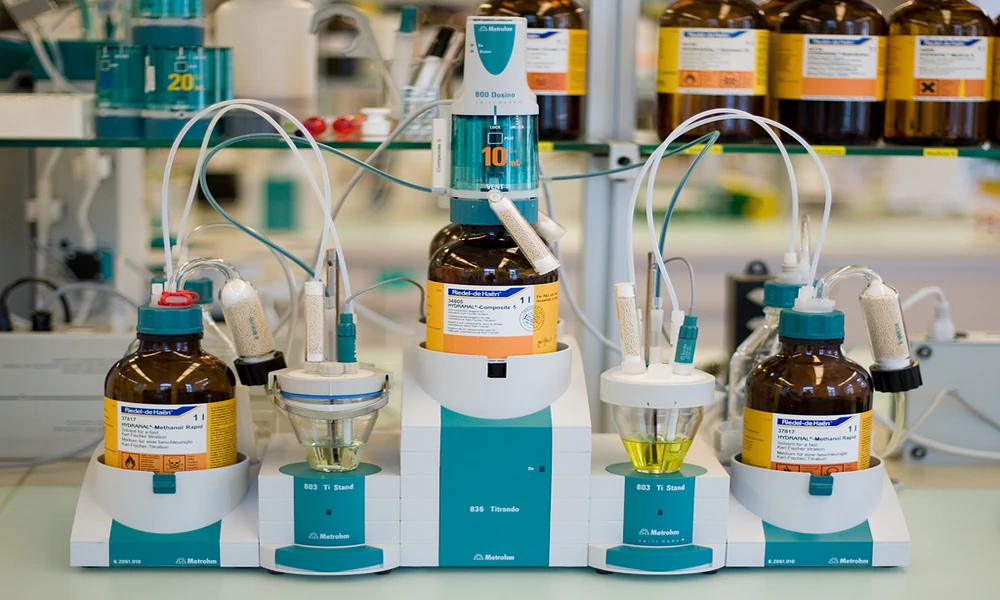
Water determination is one of the most frequently performed tests across pharmaceutical, food and beverage, petrochemical, and speciality chemical laboratories in India. Among the available methods for quantifying trace moisture, the Karl Fischer titration remains the most specific, accurate, and widely validated approach for water determination across a broad range of sample types and moisture concentration ranges. Central to this method is the KF reagent, whose composition, selection, and handling directly determine the accuracy and reliability of every water determination result produced by the titration.
What Karl Fischer Reagent Actually Is
Karl Fischer reagent composition in the original formulation, developed by Karl Fischer in 1935, comprised sulphur dioxide, iodine, pyridine, and methanol. The titration chemistry involves the stoichiometric reaction of iodine with water in the presence of sulphur dioxide and a base, with pyridine serving as both the base and the solvent stabiliser in the original formulation. This original pyridine-containing formulation was the analytical standard for decades, but pyridine’s toxicity, unpleasant odour, and increasingly stringent occupational health regulations drove the development of pyridine-free alternatives that now dominate modern laboratory use.
Contemporary KF reagent products replace pyridine with less toxic and more practically convenient nitrogen-containing bases, most commonly imidazole or ethylamine-based systems, while preserving the fundamental titration chemistry that gives Karl Fischer titration its specificity for water. These modern formulations deliver equivalent or superior analytical performance alongside considerably improved handling safety compared to the original pyridine system.
Single-Component vs Two-Component Systems
Karl Fischer reagent composition differs fundamentally between single-component and two-component titration systems, and understanding the difference is essential to specifying the correct product for a given analytical application.
In a single-component or one-component system, all titration reagents are combined into a single solution, typically comprising iodine, sulphur dioxide, imidazole, and methanol or another appropriate solvent. This KF reagent formulation is used directly in the titration vessel, with water from the sample reacting with the combined reagent solution. Single-component systems are convenient, minimise the number of reagent bottles in use, and are well-suited to routine water determination across a broad range of sample matrices.
Two-component systems separate the iodine-containing titrant from the sulphur dioxide-containing solvent, allowing the solvent composition to be optimised for specific sample types. This separation is particularly valuable for samples that are incompatible with the standard methanol-based system, such as ketones, aldehydes, samples requiring non-aqueous extraction, or matrices requiring an alternative solvent base for complete dissolution and water extraction.
Merck Karl Fischer Reagent and Grade Considerations
Merck Karl Fischer reagent and equivalent products from other established analytical chemical suppliers are produced to well-defined quality specifications that include iodine equivalence (the water equivalent per millilitre of reagent, typically expressed as mg H2O per mL), drift rate in well-maintained equipment, and stability under appropriate storage conditions. For pharmacopoeial water determination, where the method must be validated against recognised standards, using a KF reagent with documented lot-specific iodine equivalence and traceable standardisation is not optional.
When sourcing KF reagent through a Lab Chemicals Distributor in Vapi or any other distribution channel, request the lot-specific certificate of analysis confirming the iodine equivalence, the standardisation date, and the recommended storage conditions. Reagent whose iodine equivalence has drifted from its nominal value due to inadequate storage or extended post-opening exposure will produce systematically biased water determination results that may not be immediately apparent without regular standardisation checks.
Handling, Storage and Safety Considerations
Karl Fischer reagent composition includes reactive components that require specific handling precautions regardless of whether the formulation is pyridine-containing or pyridine-free. Modern pyridine-free KF reagent formulations are considerably safer than the original pyridine-based products, but still require handling in a well-ventilated area, storage in sealed containers away from moisture and light, and prompt disposal of expired or degraded reagent through appropriate chemical waste channels. The reagent should be stored according to the manufacturer’s specification, typically at controlled room temperature and protected from ambient humidity, which can degrade the reagent through reaction with atmospheric moisture.
Equipment Calibration and Standardisation
A Karl Fischer titration system is only as accurate as the current standardisation of the KF reagent in use. Most modern automated Karl Fischer titrators incorporate automated drift correction and provide real-time monitoring of reagent stability, but manual verification of iodine equivalence using a certified water standard, typically sodium tartrate dihydrate for coulometric systems or standardised water solutions for volumetric systems, remains the essential quality check that ensures the entire water determination system is performing within specification. Laboratories sourcing Merck Karl Fischer reagent or equivalent products from reputable distributors should confirm that the reagent’s lot-specific iodine equivalence matches the value being used for result calculation.
Paid GB – 2
Magnetic Stirrer Hot Plates: Selection, Specifications and Maintenance for Indian Analytical Laboratories
Few pieces of laboratory equipment are as universally present across Indian analytical, research, and quality control laboratories as the magnetic stirrer hot plate. From dissolving standard solutions and preparing reagents to supporting chemical reactions and maintaining suspension homogeneity, this deceptively simple combination of controlled heating and magnetic stirring serves an irreplaceable function across virtually every bench chemistry application. Yet the variation in quality between different magnetic stirrers available in the Indian market is considerable, and selecting the wrong specification for a given application produces results that range from minor inconvenience to genuinely compromised analytical work.
Understanding the Hot Plate and Magnetic Stirrer Combination
A hot plate and magnetic stirrer combines two independent functions into a single compact unit. The heating element, typically a ceramic or aluminium plate surface, transfers heat to the vessel placed upon it. A rotating magnetic field generated beneath the plate surface drives a magnetic stir bar inside the vessel, producing the mixing action that ensures thermal and compositional homogeneity throughout the sample. Both functions can be operated independently or simultaneously, giving the instrument the flexibility to serve applications requiring heat only, stirring only, or the combination of both.
The magnetic mixer hot plate generates its rotating magnetic field through a motor-driven permanent magnet or electromagnet system located below the hotplate surface. The coupling between this external rotating field and the magnetic stir bar within the vessel is what produces the stirring action, and the strength and consistency of this coupling determines the maximum viscosity the system can stir reliably and the maximum stir bar size that will rotate without decoupling.
Key Specifications for Selection
Selecting the correct magnetic stirrers for a specific laboratory application requires evaluation of several interrelated specifications. Temperature range is the most fundamental: standard laboratory hotplate stirrers cover ambient to approximately 300 to 340 degrees Celsius for ceramic-topped units, while specialty high-temperature models extend to 500 degrees Celsius or above. Confirm that the required operating temperature falls comfortably within the instrument’s rated range, not at its upper limit where thermal stability and control accuracy are typically weakest.
Stirring speed range determines the instrument’s flexibility across different viscosity applications. Standard magnetic stirrer hot plate instruments offer speeds from approximately 50 to 1500 rpm, sufficient for most laboratory applications from gentle mixing of precipitation reactions to vigorous stirring of low-viscosity reagent solutions. Plate size relative to the vessel footprint affects heating efficiency and should be matched to the most commonly used vessel size in the intended application.
Digital vs Analogue Control
Modern hot plate and magnetic stirrer units are available with either analogue dial control or digital display and PID temperature control. Analogue units are entirely adequate for routine reagent preparation and general dissolution work where precise temperature control and reproducibility are not critical requirements. Digital units with PID temperature control offer significantly better temperature stability and reproducibility, particularly at elevated temperatures where analogue control is more susceptible to thermal overshoot and cyclic variation. For applications where temperature precision directly affects analytical or synthesis outcomes, the investment in digital PID control is justified by the improvement in reproducibility it delivers.
Chemical Resistance and Plate Material Selection
The choice between ceramic and aluminium hotplate surfaces is primarily determined by the chemical environment in the laboratory. Ceramic surfaces offer excellent resistance to acid and alkali spills and are significantly easier to clean after contamination than aluminium, which can be permanently stained or corroded by spilled reagents. For laboratories working routinely with corrosive chemicals, mineral acids, or alkaline reagents, ceramic-topped magnetic stirrers are strongly preferable despite their generally higher cost. Aluminium surfaces offer faster heating and more uniform temperature distribution in some configurations, which may be relevant in applications requiring rapid temperature ramp-up.
Rankem Distributors India and Quality Sourcing
When sourcing magnetic stirrer hot plate equipment through established channels such as Rankem Distributors in India and equivalent quality laboratory equipment suppliers, request documentation of the instrument’s calibration status, warranty terms, and availability of local service support. Laboratory instruments that malfunction without accessible service support create operational disruption disproportionate to the cost of the instrument itself. Established distributors who maintain service capability alongside supply represent considerably more value for laboratory operations than those supplying equipment without post-purchase technical support.
Maintenance Practices That Extend Service Life
A magnetic mixer hot plate maintained correctly will provide reliable service across many years of laboratory use. The most important maintenance practices are straightforward: keep the hotplate surface clean and free from spilled reagents that can harden and damage the surface or interfere with temperature uniformity; inspect the power cord and temperature sensor connections periodically for signs of damage; and replace stir bars when their PTFE coating shows signs of chipping or wear, since damaged stir bars can introduce contaminants and couple less reliably with the external magnetic field. Annual verification of temperature accuracy against a calibrated reference thermometer ensures that temperature-dependent results remain reliable over the instrument’s service life.
Paid GB – 3
Laboratory Vacuum Ovens: Applications, Specifications and Sourcing Guidance for Indian Laboratories
The vacuum oven addresses a specific and important analytical challenge that a standard laboratory oven cannot: the need to apply heat to temperature-sensitive or oxidation-prone materials without the thermal degradation or oxidative damage that heating at atmospheric pressure in an air environment would cause. By combining controlled heat with reduced pressure, the laboratory vacuum oven creates conditions that allow moisture removal, solvent evaporation, and material drying at temperatures well below the boiling points or decomposition thresholds that would be reached under atmospheric conditions, making it indispensable across pharmaceutical, food science, polymer, and electronic materials laboratories.
Why Vacuum Changes the Drying Equation
The relationship between pressure and boiling point is fundamental to understanding why a vacuum oven enables lower-temperature drying. At atmospheric pressure, water boils at 100 degrees Celsius. At a pressure of 50 mbar, water boils at approximately 33 degrees Celsius. At 10 mbar, the boiling point drops to around 11 degrees Celsius. This pressure-dependent boiling point reduction means that a laboratory vacuum oven operating at moderate vacuum can remove moisture from a heat-sensitive material at temperatures that would cause no thermal damage, while the equivalent drying process in an atmospheric oven would require temperatures that degrade the material.
For solvents with even lower atmospheric boiling points than water, the vacuum advantage is even more pronounced. Ethanol, for example, boils at 78 degrees Celsius at atmospheric pressure but can be removed at room temperature under sufficient vacuum. This makes the vacuum oven essential for recovering solvent-exposed materials without the residual solvent contamination that inadequate drying at insufficient temperature would leave behind.
Primary Applications Across Indian Laboratories
Vacuum oven use in Indian laboratories spans several distinct application categories. In pharmaceutical quality control and formulation research, loss on drying (LOD) determination by vacuum drying is specified in pharmacopoeial monographs for moisture-sensitive active pharmaceutical ingredients and excipients where conventional oven drying would cause thermal decomposition. In polymer research and materials science, vacuum drying removes residual monomer, catalyst, or processing solvent from polymer samples without the thermal oxidation that atmospheric drying at equivalent temperatures would produce.
In food science and nutrition analysis, vacuum drying of fat extracts, protein isolates, and carbohydrate fractions allows accurate gravimetric determination without the oxidative rancidity or moisture reabsorption artefacts that atmospheric drying can introduce. In electronic component manufacturing quality control, vacuum baking of printed circuit boards and sensitive electronic assemblies removes residual moisture without the oxidative damage that conventional oven temperatures would cause to sensitive metallic and polymeric components.
Key Specifications for Laboratory Vacuum Oven Selection
Selecting a laboratory vacuum oven requires evaluation of several interconnected specifications. Temperature range and uniformity determine the instrument’s suitability for specific drying and testing applications. Standard laboratory vacuum ovens cover temperature ranges from ambient to approximately 200 or 250 degrees Celsius, with more specialised models extending to higher temperatures for applications in polymer processing and materials characterisation.
The vacuum level achievable and the system’s ability to maintain that vacuum throughout a drying cycle are equally important. Applications requiring very low residual moisture levels, such as pharmaceutical LOD testing to pharmacopoeial standards, typically require vacuum levels in the range of 1 to 10 mbar. Standard laboratory vacuum ovens achieve ultimate vacuum levels of approximately 10 to 100 mbar depending on the quality of the vacuum pump and the integrity of the chamber and door seals. Confirming that the specified vacuum level is achievable with the intended pump configuration, rather than relying on manufacturer claims that assume an idealised system, is an important step in the selection process.
Chamber Construction and Material Compatibility
The internal chamber of a vacuum oven is typically constructed from stainless steel, which combines the required chemical resistance with adequate strength to withstand the pressure differential between the evacuated chamber interior and the atmospheric pressure outside. The door seal material, most commonly a silicone or EPDM gasket, must maintain an adequate seal across repeated thermal cycling and exposure to the solvents and vapours present in the specific application. For applications involving aggressive solvents or corrosive vapours, confirming seal material compatibility with the specific substances being handled is essential before operating the oven.
Borosil Distributors in India and Quality Equipment Sourcing
Borosil Distributors in India and other quality laboratory equipment channels supply vacuum oven products from established manufacturers whose temperature uniformity, vacuum achievement, and long-term reliability have been validated across demanding laboratory environments. When evaluating vacuum oven options through these channels, request documentation of the oven’s temperature uniformity across the chamber interior, verified by multiple-point thermocouple mapping rather than by a single thermocouple reading at one location. Temperature non-uniformity within the chamber is one of the most common causes of irreproducible drying results, and it is a specification that product photographs and basic catalogue listings do not reveal.